Real Disposable Income Per Capita Up 0.2% in May
Membership required
Membership is now required to use this feature. To learn more:
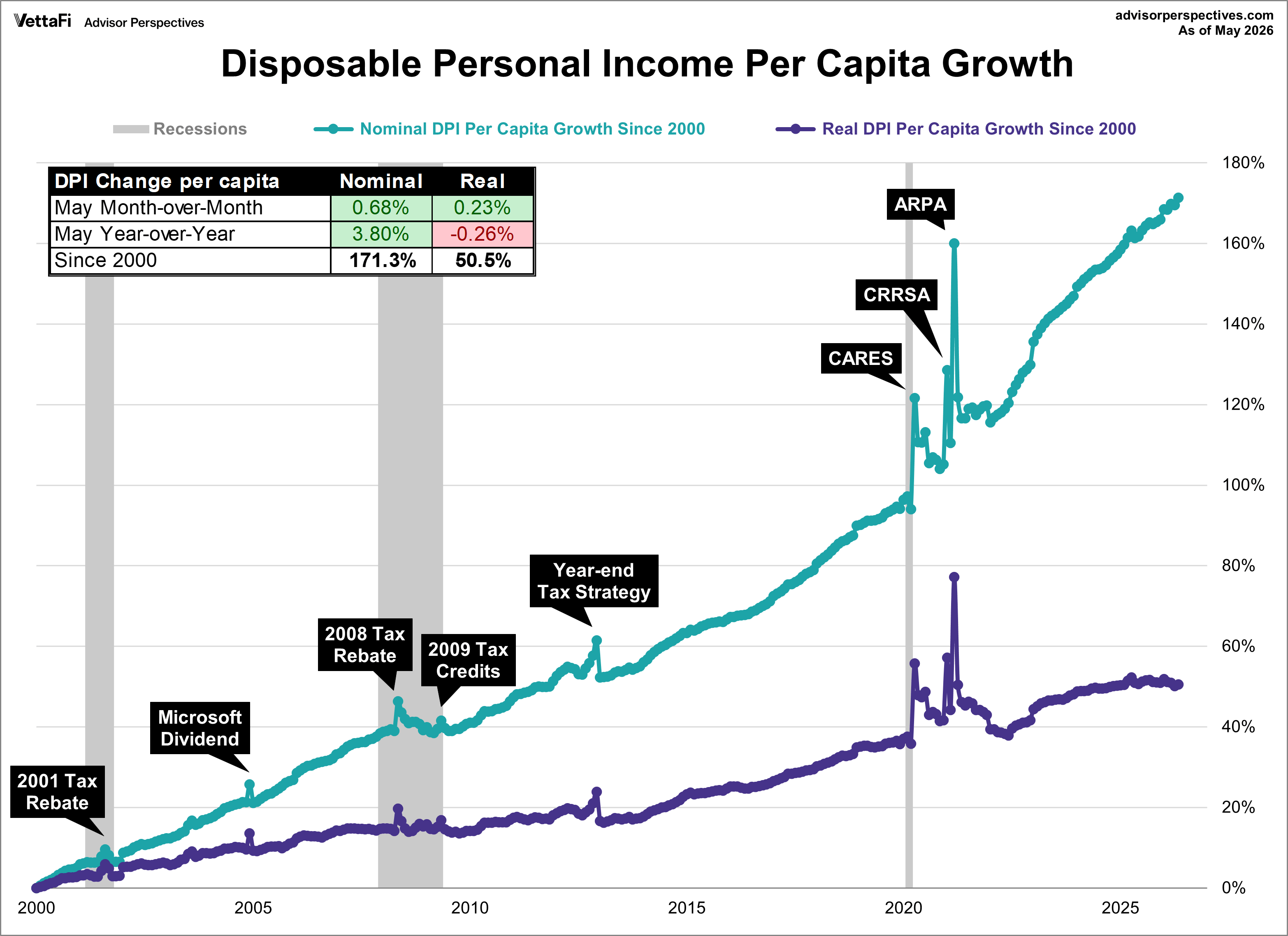
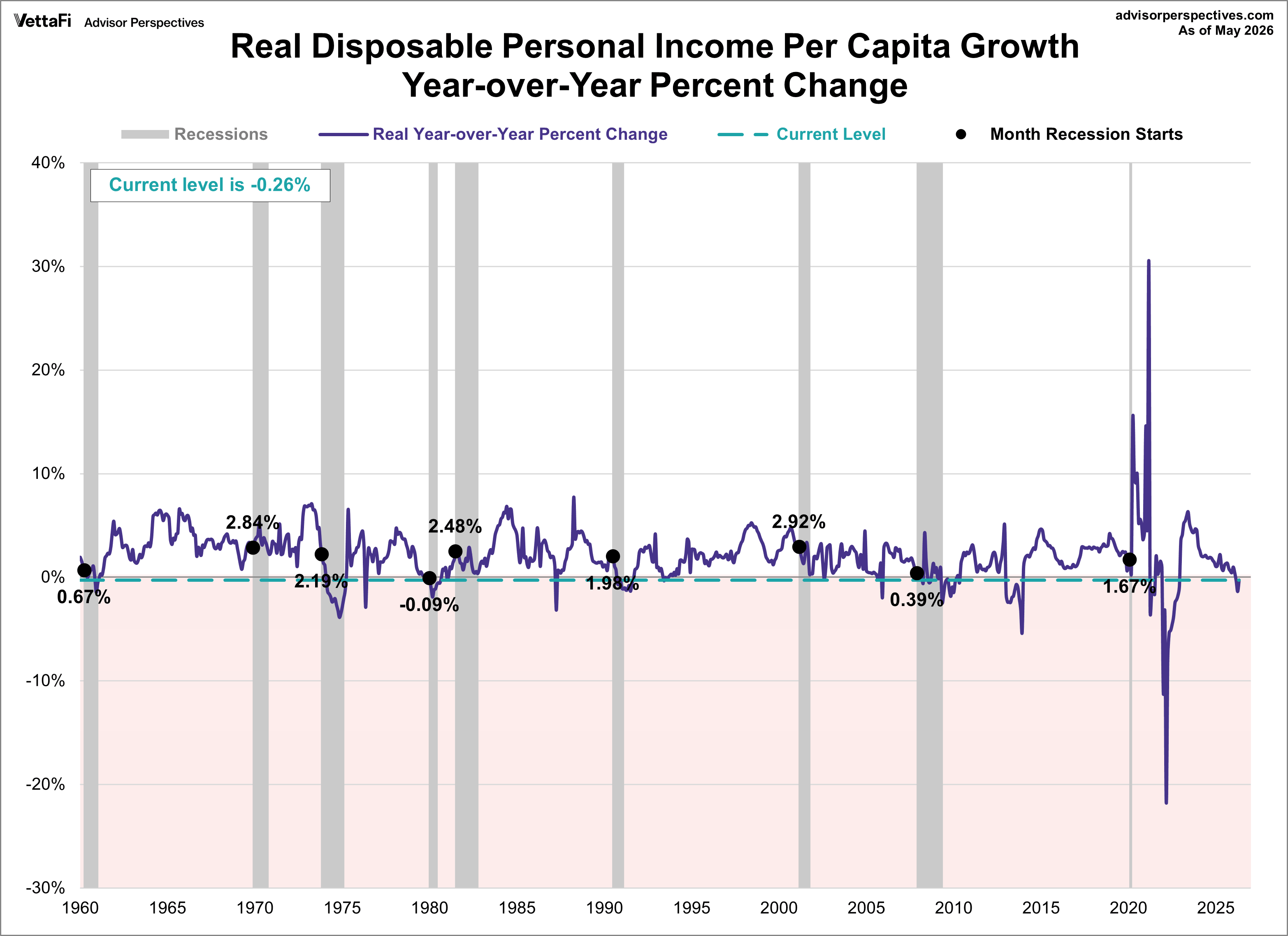
View Membership BenefitsWith the release of May's report on personal incomes and outlays, we can now take a closer look at "real" disposable personal income per capita. To two decimal places, disposable income per capita was up up 0.68% month-over-month. But when adjusted for inflation, real disposable income per capita was up 0.23%. The year-over-year metrics are 3.80% nominal and -0.26% real.
Disposable Income
Disposable income is the amount of personal income that remains after income taxes have been deducted. Real disposable income is the post tax and benefit income after an adjustment has been made for price changes. This economic indicator is monitored to see how consumers save, spend, and borrow.
Post-great recession, the trend was one of steady growth, but generally flattened out in late 2015 with increases in 2012 and 2013. As a result of COVID pandemic stimulus measures, major spikes can be seen in April 2020, January 2021 (a December 2020 payment), and March 2021.
The first chart shows both the nominal per capita disposable income and the real (inflation-adjusted) equivalent since 2000. This indicator was significantly disrupted by the bizarre but predictable oscillation caused by 2012 year-end tax strategies in expectation of tax hikes in 2013 and more recently, by COVID stimulus.
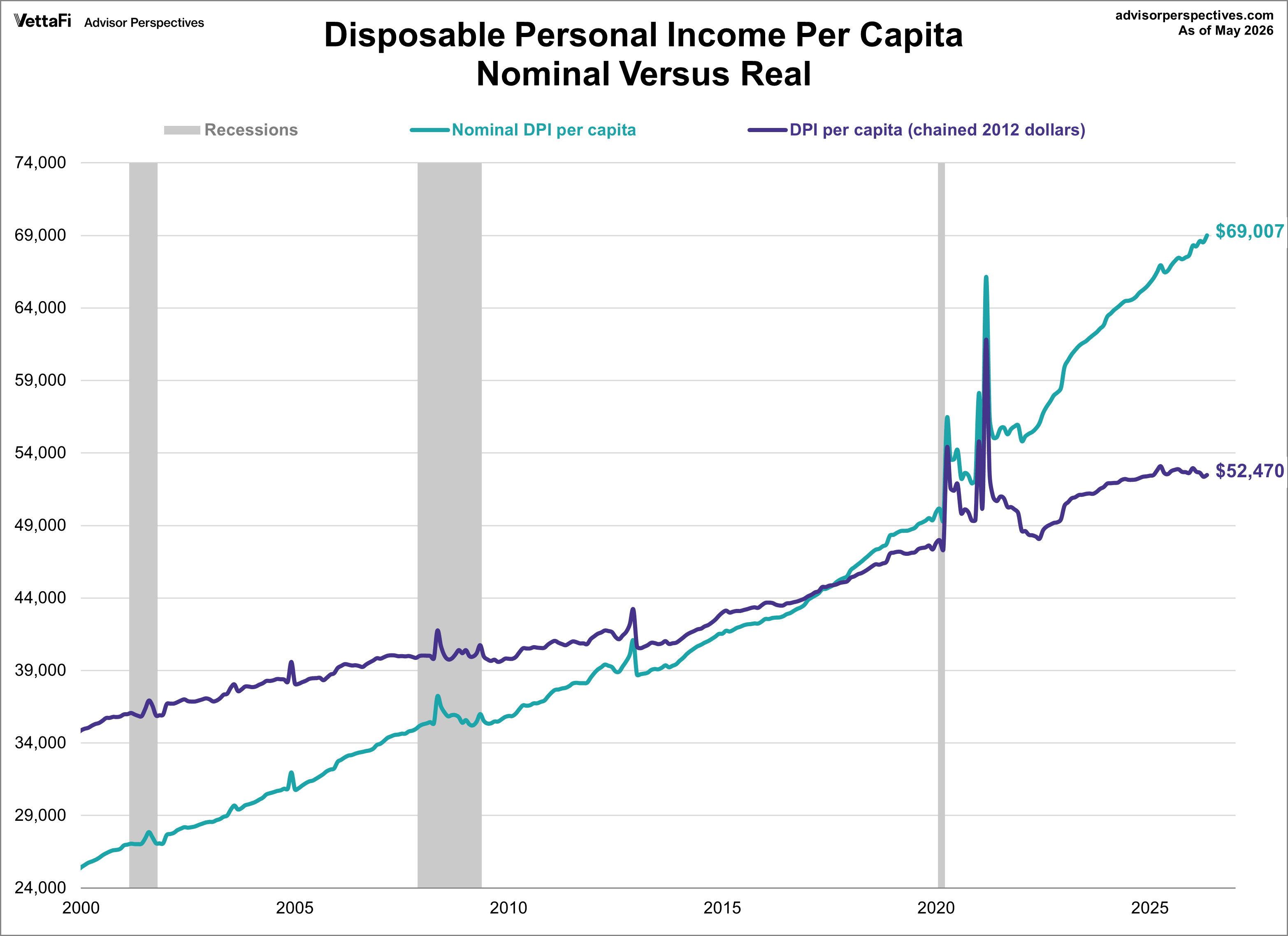
The BEA uses the average dollar value in 2017 for inflation adjustment. But the 2017 peg is arbitrary and unintuitive. For a more natural comparison, let's compare the nominal and real growth in per-capita disposable income since 2000. Do you recall what you were doing on New Year's Eve at the turn of the millennium? Nominal disposable income is up 171% since then. But the real purchasing power of those dollars is only up 50%.
Disposable Income per Capita
Let's take one more look at real DPI per capita, this time focusing on the year-over-year percent change since the beginning of this monthly series in 1959. The chart below highlights the value for the months when recessions start to help us evaluate the recession risk for the current level. The current real YoY of -0.26% is at or below 9 of the 9 recessions since 1959.
Consumption Versus Savings
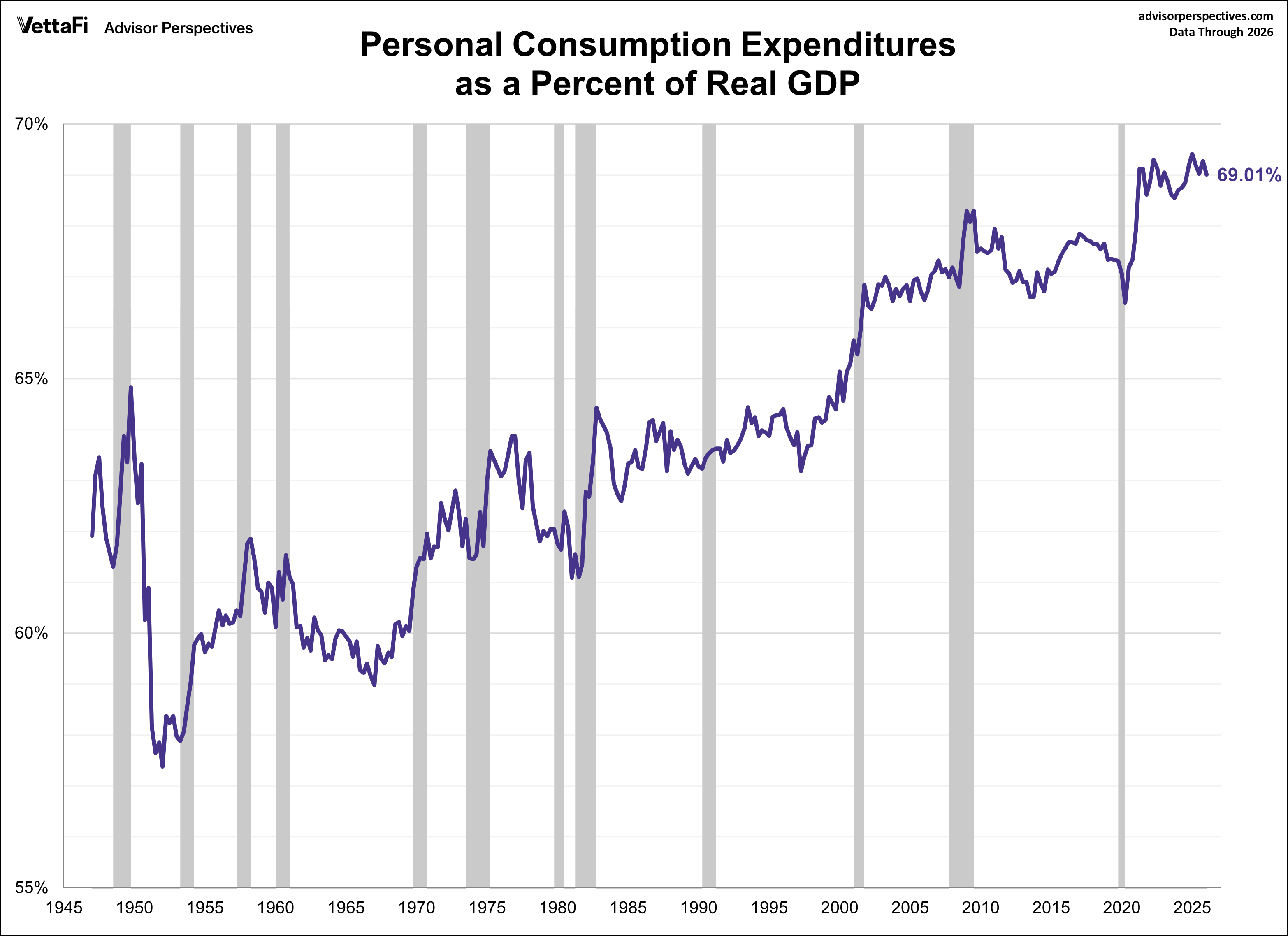
The US is a consumer-driven economy, as is evident from the percent share of GDP represented by PCE.
Since consumption must be funded, the most sustainable source is growth in real disposable income. Absent that, the only alternative to support higher spending is to draw down savings. This next chart shows the personal savings rate, which is the percentage of disposable income that goes into savings. The dots show the monthly data points and the purple line is the 12-month moving average which gives a better view of the overall trend. In May, the personal savings rate was unchanged at 3.0%, remaining at its lowest level since June 2022. The 12-month moving average is now at 3.90%, the lowest level since March 2023.
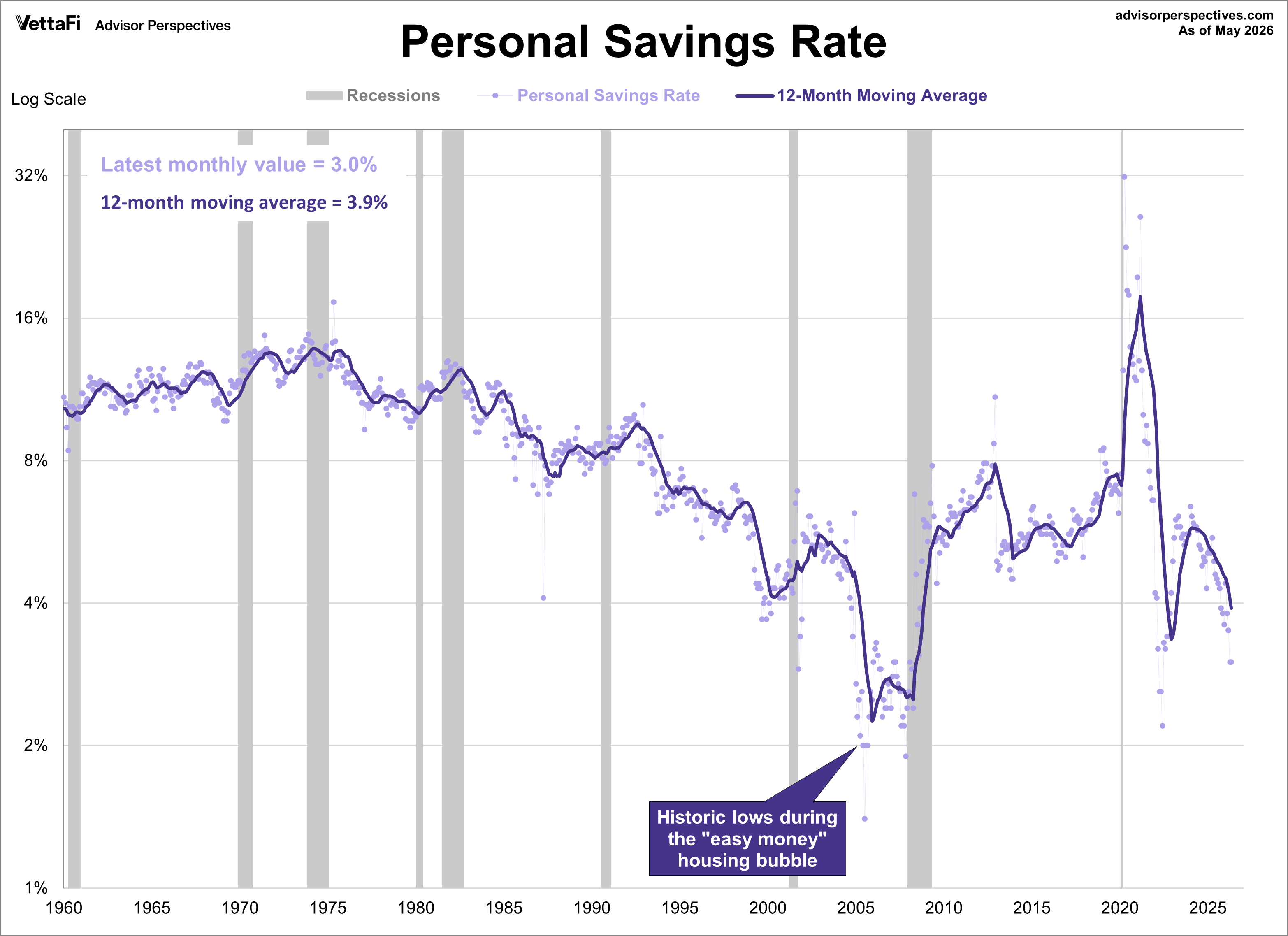
As the chart above illustrates, the US savings rate had generally declined since the early 1980s, a trend no doubt supported by the psychology of the secular bull market from 1982 to 2000. After stabilizing for a couple of years following the tech crash, a new surge in asset-growth confidence in residential real estate was probably a factor in that trough in 2005 — along with the "easy money" financing of those years. But in 2008, the financial crisis reversed the trend … for a while. We've recently seen the highest personal savings rate since the 1980s, which was a direct response to the COVID-19 global pandemic via three rounds of stimulus payments, followed by the lowest personal savings rates since the housing bubble.
Here is a close-up of the 21st century using the more familiar linear vertical axis. The addition of the callouts helps to explain the outlier months when a one-off surge in income momentarily showed up as savings. These are typically followed by a sharp drop-off in the savings rate in the following months as the one-off dollars are spent. Note that this chart uses a 3-month moving average unlike the 12-month MA in the chart above, hence the greater volatility in the trend. In May, the 3-month moving average was at 3.17%, the lowest level since August 2022.
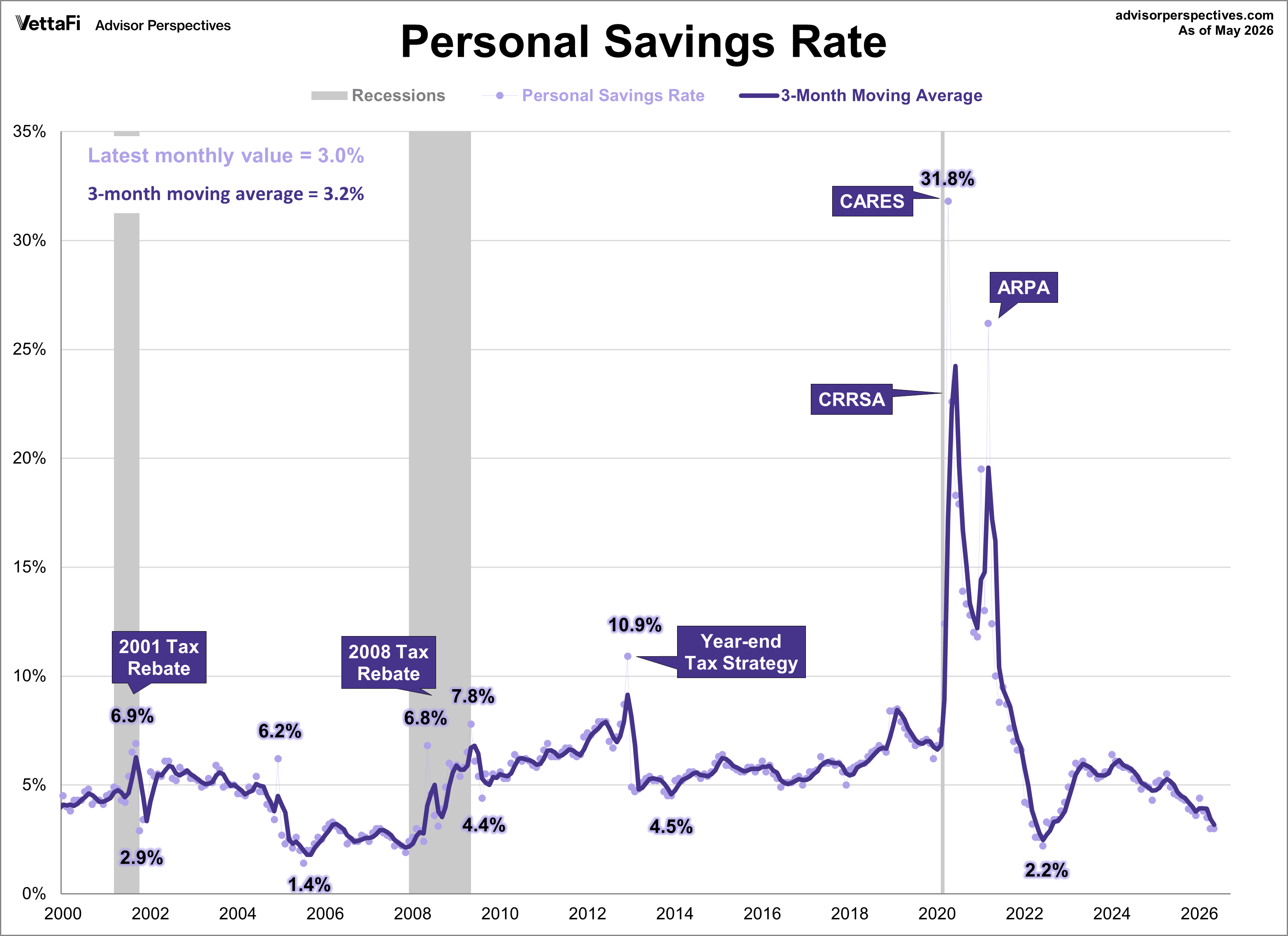
The trend zigzagged upward after the recession, dropping again in 2013. Personal savings bounced up and down since then, but had not made any real progress. In any case, the probability of reductions in retirement entitlements in the years ahead may eventually lead the savings rate back to the levels in the 1970's and 80's. The COVID-19 pandemic has brought about a new round of savings harkening back to 1980s levels, but has quickly changed pace - we are now at pre-great recession levels.
For some additional commentaries on income and wages, see the following:
Membership required
Membership is now required to use this feature. To learn more:
View Membership BenefitsSponsored Content
Editorial Calendar
View Full Calendar Eastern Time Zone
+ Add the editorial calendar to your Google Calendar.
Upcoming Virtual Events View All