Advisor Perspectives welcomes guest contributions. The views presented here do not necessarily represent those of Advisor Perspectives

On January 1, 2000, Jim Smith invested with Manager X. Jim had done his homework: he had compared Manager X’s performance over the prior decade against the relevant benchmark. Although Manager X stumbled in 1990, his returns had beaten the S&P 500 every year after that. This outperformance is illustrated in the following graph. If you had invested $1.00 with Manager X on January 1, 1990 it was worth $7.05 on December 31, 1999 (see green), far in excess of the $5.32 earned by the S&P 500 (see red).
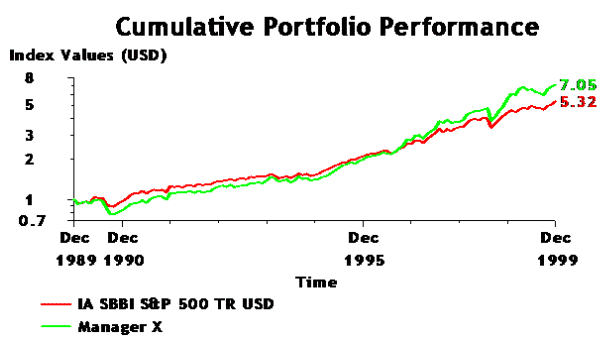
Jim dug even deeper and reviewed several years of analysts’ reports. They were unanimous. Manager X’s performance warranted a role as core equity holding. Jim also hired his own financial analyst to analyze Manager’s X’s performance from a risk–adjusted perspective. Again, Manager X came through with flying colors. Although his returns were more volatile than the S&P 500, his higher returns more than compensated for the bumpier ride. With his homework done, Jim confidently selected Manager X as his core U.S. equity manager and allocated him a sizeable portion of his portfolio.
Fast forward to December 31, 2009, and Jim is ruefully assessing the results of his selection decision. Although Manager X’s performance had outstripped the S&P 500 through the first half of the decade, he suffered massive losses in the market meltdown. Every $1.00 Jim invested with Manager X in 2000 was worth 72 cents (see green) at the end of the decade, more than 20% less than the 91 cents yielded by the S&P 500 (see red).