A Response to 'A Winning Endgame'
Membership required
Membership is now required to use this feature. To learn more:
View Membership BenefitsAdvisor Perspectives welcomes guest contributions. The views presented here do not necessarily represent those of Advisor Perspectives.
A Winning Endgame, Robert Huebscher’s review of John Mauldin’s book Endgame, made some highly problematic claims about our energy usage. Moreover, Huebscher’s claim is unfounded that an energy policy, such as the cap-and-trade policy he recommended, is the right step toward solving our economic crisis.
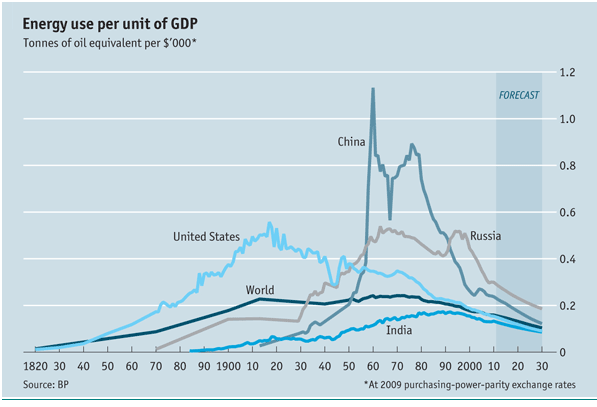
Efficiencies increase, and thus as time goes by, we are requiring less and less energy to do what we as humans do. This is generally true with respect to energy from any and all sources. It's a function of inexorable Schumpeterian technological advancement, not some hoped-for futuristic thing that awaits the spur of government policy.
Note the marked and persistent convergence to the deep south shown in the graph below. If you contemplate the veritable onslaught of virtuality opening up all around us, you will think the downward slope of the curve will, at some future point, steepen considerably, as virtual activity (and for that matter, nano-activity) requires only a minute fraction of the energy traditional physical activity requires.
To be clear, economics is not only the dismal science, but it also is sometimes a very counterintuitive-to-the-point-of-nearly-perverse one. Our increased energy efficiency, or as energy economists refer to it in the converse, decreased energy intensity, is not a simple function of the regulatory apparatus run amok ala CAFE standards. In fact, despite continued and typically shamelessly ideologically motivated attempts (most of which are by non-economists who don't understand the analytical value of mathematically isolating variables) to "debunk" the very-real world and empirically observable impact of Jevons Paradox, the phenomenon persists as a near-perfect poster child for the concept of face validity. This is one of the classic examples of the seeming perversity of economic efficiency mandates.
Step back and ponder for just a moment with William Jevons and me. The incredible efficiency of internal combustion engine technology, as opposed to coal-fired steam engines, is the textbook example. In the ceteris parabis (all held equal) case, the more efficient we can render an energy source, the more of it we use and demand. While corporate average fuel economy (CAFE) standards did not create electronic fuel injection (EFI) technology (which preceded CAFE standards by a decade), EFI has probably done more than any other single phenomenon to assure continued long-term reliance on petrol, and for good reason. A new 2011 Dodge Charger literally gets 250% of the mileage (25 mpg hwy v 10 mpg hwy) of the 1972 version I drove in high school, and with 15-20% more horsepower to boot. Would that kind of radically increased efficiency that has occurred in just two-thirds of my short 58-year lifetime lead a rational society to revert to steam engines or horse-and-buggy transport (or covering an area the size of the state of Arizona with solar panels)? I should hope not.
Bureaucratic contrivances such as ethanol and scaled or grid-based (not distributed) solar and wind power are nothing but obscenely wasteful boondoggles. Nuclear falls in a category all its own. To the extent technological issues around safety and spent fuel disposition can be satisfactorily addressed, both scaled and centralized and perhaps more especially distributed, nuclear power generation can make increasing sense. (See Dr. Sen's National Renewable Energy Lab presentation for more information about this.)
A critically important point to understand and appreciate is the increasingly inferior economics of conventional centralized power generation versus distributed (localized) power generation options —not even counting substantive negative externalities of macro grid systems. Wind, to some extent, and especially solar actually have some real (economic) viability when deployed selectively and thoughtfullyin a distributed manner. One quite promising avenue in the distributed power generation (DPG) sphere that a handful of firms are already pursuing with some good promise is the use of distributed "mini" nuclear reactors. These truck- and in some instances automobile-sized devices are already operating in beta mode to power commercial/industrial facilities, and microwave oven-sized "countertop" units are being designed and tested to power residences. The use of these devices originated with the military's application for self-contained surface and submarine naval vessels and is beginning to expand commercially.
Scaled wind farms are an absolute economic nightmare, not even counting the massive negative externalities costs. They entail far more reliance on foreign (enemy?) resources than does petrol or natural gas, as China pretty much has the market cornered for the rare earth magnets required in the bus-sized turbines (whose mechanical apparati have about half the relatively short 20-30 year useful life we originally thought).
For practical purposes, the Middle East has far less of a stranglehold on our oil supply than most think. This is the case from three standpoints. First, OPEC is a demonstrably loose cartel whose members cheat virtually anytime they believe it to be in their own near-term interest. Second, true and lasting punitive embargoes are no longer economically feasible, as the market for petrol has become too developed and too global. Once a supertanker clears the Straits of Hormuz and gets into open international waters, its cargoes instantly become broker-able to the highest bidder, even if that happens to be us. Thirdly, due to technologies, markets and their price feedbacks, our developable domestic reserves are now expanding rapidly to include quite massive supplies of shale- and tar sand-based gas and liquid products, by any standard. Eventually recoverable hydrocarbon-based crystalline formations underneath much of the Earth's seabed may render conventional hydrocarbon sources and mining moot due to near limitless supply.
In sum, a massive coordinated energy policy is the absolute last thing in the world this country and the world needs us to (mis-) allocate resources towards. The heavy-handed nature of our current energy policy plays a significant (though secondary) role in our current economic malaise. We would be far, far better off allocating most of our current energy mismanagement resources to the manual digging of and subsequent refilling of holes. Just ask any hungry person or any cattle feeder how they like what we're currently doing on the energy policy front.
Now of course, if you ask a corn farmer, a cropland owner leasing to a corn farmer, those who vend them their diesel and urea- (natural gas) based fertilizers, a Deere dealership owner or, for that matter, any intentionally or incidentally parasitic economic rent seeker, you'll of course get a very different and oh-so-sincere and "green" (but perhaps not in the sense you're thinking) answer. A carbon tax of virtually any ilk is absolutely the rent seekers' ultimate dream.
Naturally occurring (not contrived or policy-manipulated) markets are much more real-time and automatically adaptive than are central planners. When unintended consequences invariably arise from centrally planned monstrosities, the typical — and perhaps laughable if not otherwise so costly and sad — bureaucratic response is to create yet another policy, regulation or apparatus that then yields yet another compounding set of unintended consequences. This cyclically compounding morass of friction is what we need to be lessening, not increasing, to unleash productivity, innovation and ultimately, a satisfactory rate of economic growth.
Very good solutions by very smart people are more readily at hand than most know. We just need to get and keep Angelo Codevilla's Ruling Class types and their arrogant power-mongering ways as suppressed and disempowered as we possibly can and allow for a continued evolutionary emergence that is inevitably unstoppable anyway. The key question becomes how much resource misallocation ala ethanol, wind farming, drilling prohibitions, etc., with all the inescapably attendant financial and human cost, do we want to incur along the way? Just how masochistically cruel and destructive do we really want to be? Remember, there is a T. Boone Pickens-style rent seeker – a whole cadre of them in fact (our system breeds them like flies) – just waiting for the next government-created opportunity to plunder our economy and retard our ability to grow out from under the federal debt monster our government policies have created.
Keep causal relationships, and especially their directions, straight. We pollute our air less than China because we have a richer, more developed economy that can more afford the luxuries of superior tidiness. I've experienced eye- and lung-burning air pollution in China first hand — in one instance, even inside the lobby of a four-star hotel. But this nightmare is improving, along with economic growth and attendant wealth creation, even in China.
Let’s now turn to Huebscher’s contention that the fear of a debt crisis may be exaggerated. He cited Yale professor Robert Shiller's notion that a fraction or ratio is inherently not useful in instances wherein the numerator is a monetary stock concept while the denominator is a monetary flow concept. This simply does not make sense to me. To the contrary, I suggest that we compare things to what it is useful and relevant to compare them to, irrespective of the respective mathematical derivations of the specific numbers selected as being useful to compare.
Banking and Credit 101 teaches us that with respect to creditworthiness considerations, the ability to repay from flows of money is considerably paramount over repayment via collateral liquidations. This point is even more salient with respect to sovereign finance because there are no international bankruptcy courts to force asset (stock) liquidations of insolvent debtor countries. In other words, to compare our nation's debt to its assets or net worth (both "stock" as opposed to "flow" concepts), as Shiller suggests would be more logical mathematically, is simply blatantly inconsistent with the practical principals of finance and credit analysis. Persons, natural or otherwise, traditionally repay accumulated (negative)stocks of indebtedness from flows of revenues, and not from asset or stock liquidations. Collateral is only a secondary or back-up plan to minimize losses associated with a failed lending endeavor. In fact, at the practical level, any experienced commercial bank loan committee member will tell you quickly that if stocks (i.e., collateralized assets or pools thereof) have to be seriously looked at, then the loan or credit is likely already in very serious trouble.
Having said that, is the monetary flow we commonly see used as the denominator, i.e., GDP, really the most useful flow-based denominator to be using? No, it is not. Dr. Thomas Saving, a nationally prominent Texas A&M economist and policy analyst, has pointed out that a considerably more useful denominator of the fraction under discussion, for the implied intended use, i.e., of discerning and measuring a sovereign's degree of indebtedness and thereby its creditworthiness, is the government's share of GDP, not the entirety of the GDP pie.
Think for just a moment about the ultimate implication of using the entirety of our GDP as the denominator of this fraction. Think like a banker. Absent a presumption of unbounded government, that approach would be like a banker considering the incomes of your neighbors along with your income in deciding whether or not to make you a loan.
Practically speaking, we likely will slog (slow growth) our way through and hopefully out of this mess with some combination of aggregate — but perhaps not per capita (the kind we can actually eat) — real GDP expansion, currency debasement — a combination tax and abrogation redistributive scheme — and gradual public- and perhaps continued private-sector delevering. Even if the coming elections result in a massive repudiation of our incredibly entrenched and destructive Ruling Class leadership, and the statist types are thoroughly tossed out on their deluded, self-serving, more-government-is-better-government ears, we are currently way behind the debt and regulatory state eight-ball with lots of damage already done.
Righting the economic ship won't likely be quick or easy. We can do it, though, and I am betting on it investment-wise.
Guy M. Cumbie, CFP®, CIMA®
Cumbie Advisory Services, Inc.
Fort Worth, TX
Membership required
Membership is now required to use this feature. To learn more:
View Membership BenefitsSponsored Content
Upcoming Virtual Events View All