Advisor Perspectives welcomes guest contributions. The views presented here do not necessarily represent those of Advisor Perspectives.
Financial stocks have been hit hard by the current economic crisis, causing most index providers to categorize them as deep value. But this categorization is arbitrary, potentially misleading and can distort reported performance calculations.
Most providers use price/book as the style differentiator. As prices declined book values have not because underwater mortgages remain on the books near their origination value. Book values of distressed banks are grossly overstated. Consequently price/book ratios are grossly understated.
By contrast, earnings have fallen even faster than the prices of these companies, so a price/earnings classification places these financials well into the growth category.
In other words, style classifications have become debatable. Are financials now cheap (value) or speculative (growth)? What do you think? Here’s a clue: The president of Bank of America recently declared that he runs a growth company.
Russell and others use price/book while Surz Style Pure® uses price/earnings. This disagreement has caused the performance of style indexes to differ dramatically, so it’s become very important to know how these style sausages are made. The following two graphs provide some insights and details.
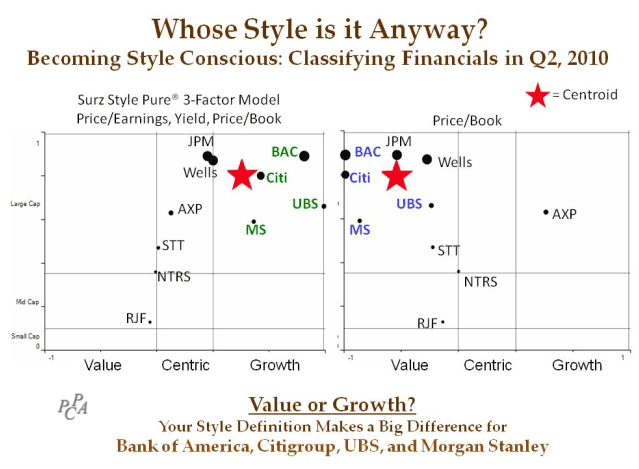
The price/book definition views Citigroup and Bank of America as deep value, whereas the price/earnings definition sees just the opposite, locating these companies as aggressive growth. Please visit Style Classifications for a detailed discussion of the different style classification methodologies.