Advisor Perspectives welcomes guest contributions. The views presented here do not necessarily represent those of Advisor Perspectives.
Much of the angst faced by investors and advisors over the last several years was caused by mismatched perceptions regarding investors’ appetite for portfolio risk. Advisors overestimated the amount of risk investors were comfortable being exposed to within portfolios. For example, based on advisor and investor surveys conducted by Cerulli over the past 18 months, only 9% of investor households classified themselves as aggressive investors, but advisors estimated that 15% of their clients were aggressive investors.
Exhibit 1: Household vs. Advisor Risk Assumptions, 2010
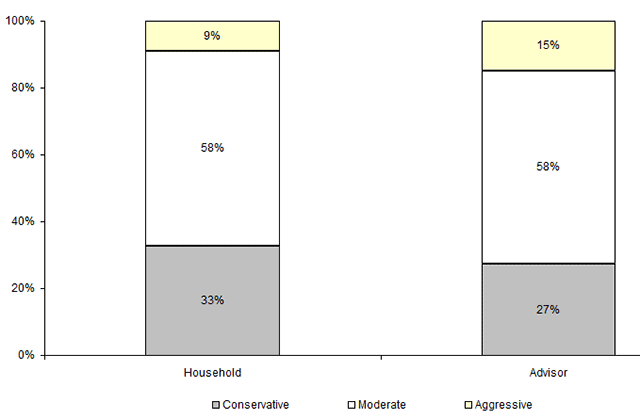
Advisors tend to overestimate the amount of risk to which investors are comfortable being exposed within portfolios.
Sources: Phoenix Marketing International, Cerulli Associates in partnership with Advisor Perspectives
Immediately after meeting a prospect and prior to any asset allocation decisions, advisors often place a risk-profiling questionnaire in front of the investor. Many contain as few as seven questions to determine the path of the relationship and see into the soul of the investor. How old are you? What do you expect of your portfolio if the market goes down for 10 years? For three years? For three months?
While these questions serve as interesting conversation starters, they don’t help an advisor truly understand an investor’s preferences or ability to comprehend or absorb market volatility. Yet across much of the industry, this is the extent of an advisor’s inquiry into the subject. Just by answering these seven questions, an investor’s needs and wants are supposed to become clear.
What exactly is an advisor trying to determine in the risk profiling process? In most cases, an investor has a goal in mind (most likely retirement), and an advisor will take all the investor’s known variables (age, income, current assets) into account to construct a portfolio that will target the highest expected return given an appropriate risk level, as determined by a risk profiling questionnaire. Rarely is the amount of risk going into a client’s portfolio discussed or even mentioned. Is the risk level the highest the investor could endure, the lowest that ensures baseline needs will be met or somewhere between the two?
Clarifying these questions is difficult. Advisors want to create a relationship of trust, and for the most part, investors are not that interested in the intricacies of how a portfolio works. Further exacerbating this condition are advisors’ fears that clients may begin to question advising decisions or perceive lower value in the advising relationship as their understandings of portfolio dynamics increase.
This leaves a scenario in which investors’ performance expectations are more likely to be set by water-cooler talk, snippets from television shows or online financial commentary than via a thorough conversation with an advisor. Even those investors who express interest in knowing more about their investments are likely to be shown a backward-looking hypothetical portfolio illustration with amazingly prescient investment selections exhibiting a best-case scenario.
Additionally, client risk appetite changed in reaction to recent market events. The number of investors who identify themselves as conservative, for example, has spiked since 2008. These shifts result in over-conservatism at the beginning of bull markets and over-aggression at market peaks. Despite their strategic plans, many advisors and investors react to short-term volatility, undermining their long-tem planning and creating significant drag on portfolio performance. As a result of these reactions, mutual fund investors underperformed the market by 1.5% annually in the last decade, according to Morningstar.