The first quarter of 2012 was a welcome respite for investors, but as markets climb higher, questions inevitably arise about the sustainability of the rally. Though growth is slowing in much of the emerging world and the Eurozone’s periphery, the recovery in the U.S. appears to be on increasingly solid footing, which may help support asset prices. Risks clearly remain, but overall, the optimism of the first quarter appears to be warranted. In this issue.
Jerry Webman, Chief Economist, explains why he believes the current U.S. recovery is sustainable and examines key risks, including
- Potential fiscal drag in 2013
- The possibility of unchecked inflation down the road
- The Eurozone debt crisis
- The prospect of slowing Chinese growth
Art Steinmetz, Chief Investment Officer, argues that massive global liquidity injections, areas of improving economic fundamentals and attractive valuations offer reason for continued optimism. In the current environment, he favors
- High yield and international bonds
- Dividend-paying and emerging market equities
Global Economic Forecast
Climbing the Wall of Worry
Jerry Webman, Chief Economist
The now-familiar economic midsummer swoon will not repeat in 2012. This economic recovery is real and will not fade out for the third time in as many years. I recognize that these words will encounter a degree of skepticism. As unconvinced investors search for the next yet-to-be-identified event to bring down the global economy, the greater likelihood is that the Black Swan event of 2012 will be: that there will be no Black Swan event of 2012.
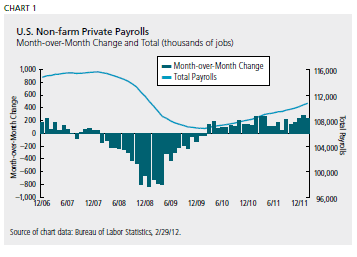
As the economy convalesced over the past three years, markets have climbed the proverbial wall of worry; they have farther to go. Consider the progress we’ve made during the three years since equity markets’ 2009 low point. Major banks are no longer on life support but have passed repeated stress tests, and several are initiating dividends. The private sector is no longer hemorrhaging jobs but has instead added 1.2 million jobs over the past six months (see Chart 1). Americans are on track to buy 15 million cars per year, and even home prices have broadly stabilized.
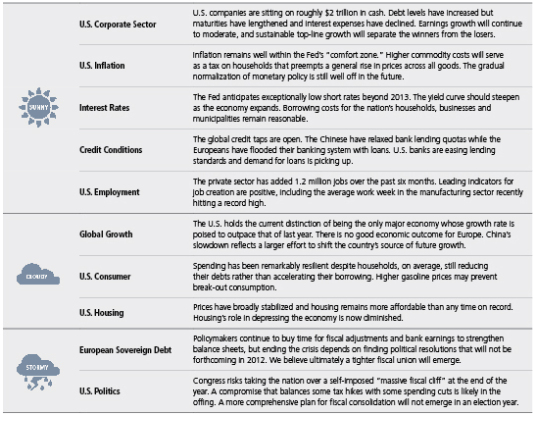
Despite the progress and U.S. consumers’ remarkable resilience, public sentiment still reflects disappointment with the overall rate of economic improvement. With U.S. households on average still reducing their debts rather than accelerating their borrowing, as we typically have after recessions, growth has been frustratingly slow. Election year acrimony and rising gasoline prices are also intensifying the general gloom. Without denying that markets and the economy face serious issues, I believe that investors who focus on improving trends will be able to see opportunity through that gloom.
As the Saudis now turn on the oil spigot to lower prices and pre-empt a slowdown in global growth, so too have the credit taps begun to open. The Chinese have relaxed bank lending quotas, and the Europeans have flooded their banking system with over €1 trillion in loans. Central banks from Brazil to Thailand have eased monetary policy, reversing their inflation-fighting postures as growth moderated and prices stabilized. U.S. banks are easing lending standards as demand from auto loans to credit card loans to commercial and industrial loans has risen. And more jobs mean more paychecks and more demand. We are not going back to the spendthrift days of yore, but the coordinated credit relaxation across many of the world’s economies will boost activity in 2012 A virtuous cycle of improving credit conditions and stronger job creation fostering greater consumption, better profits and additional hiring is in swing.
Make no mistake. The risks are significant but they represent the wall markets must climb. I’ll review four of those risks: 1) U.S. fiscal cliff and replay of the debt ceiling debate, 2) unchecked inflation, 3) unsolved European sovereign debt crisis and 4) China growth slowdown. Remember, when everyone has stopped worrying, it’s time to sell.
The fiscal cliff
Comparisons are far-fetched between the U.S.—with its global reserve currency, ready access to global capital markets, productive workforce and adaptive corporate culture—and Greece with its limited economy and someone else’s currency. Nevertheless, the U.S. fiscal deficit demands sound policy, and I’ve yet to hear a realistic plan. I won’t be the one to cut this Gordian Knot, but I do know that drastically raising taxes and/or cutting spending during a nascent economic expansion can only exacerbate the problem. That is a lesson we can learn from Greece, but it’s a lesson that might be drowned in political brinksmanship.
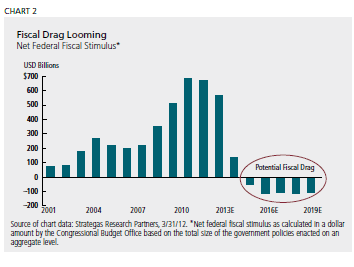
In Chairman Bernanke’s words, Congress risks taking the nation over a self-imposed “massive fiscal cliff” at the end of the year (see Chart 2). Some may consider 2013 a very unlucky number as the nation faces more than $400 billion in tax increases ominously timed to coincide with the end of stimulus spending from the American Recovery and Reinvestment Act. Compounding the problem, the Federal government may hit its debt ceiling again as early as November. While we can expect Congress and the administration to avoid an actual payment default, another credit rating downgrade is all but inevitable, and the painful but necessary comprehensive plan for longer term fiscal consolidation is a dream in an election year Is a “Thelma and Louise” moment off the fiscal cliff inevitable? It’s not. For all its dysfunction, Congress and the administration did extend the Bush-era tax cuts at the end of 2010 and the payroll tax holiday in early 2012. I expect a deal in early 2013 that balances some tax hikes with some spending cuts in a fashion that reflects the results of the election and avoids action that would plunge the economy into recession. But the $10.8 trillion the federal government already owes to foreign and domestic bondholders will ultimately have to be repaid and our elected officials will have to balance its promises with the nation’s ability and willingness to pay for them.
Unchecked inflation
The 1970s Fed Chairman Arthur Burns infamously spoke of the anguish central bankers face when employment lags and inflation threatens. In retirement, Burns recognized the damage done by erring on the side of easy money and inflation1. Will Chairman Bernanke be similarly anguished?
Extraordinarily accommodative Fed policy has helped restore health to the U.S. financial system, repair credit conditions and defeat deflation. Ten-year inflation expectations are running at roughly 2.5%, well within the Fed’s comfort zone, but unemployment remains troubling at 8.3%. If, as I expect, credit conditions continue to improve and economic momentum gradually builds, will today or tomorrow’s Fed be willing to snatch away the monetary punchbowl?
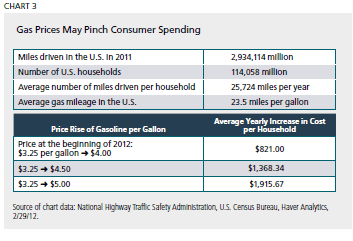
Inflation is not yet a concern. Higher commodity costs, especially gasoline prices, act as a tax on households that preempts a general rise in prices across all goods (see Chart 3). Inflation would attack if the Fed, as it did in the 1970s, were to compensate for that “tax” by keeping policy too lax for too long. Investors need to be vigilant, but I expect the Fed to employ tools including interest paid on bank reserves and maturing short-term assets on its balance sheet, before eventually raising interest rates to stanch inflation. Gradually normalizing policy rather than derailing economic expansion would validate the strength of the underlying economy. Bernanke will not succumb to the torment that befell Arthur Burns. As economic momentum picks up, I expect the Fed to use the tools at its disposal appropriately.
European sovereign debt crisis
The Eurozone will survive. The pundits had warned that restructuring privately held Greek debt and triggering credit default insurance would knock the earth off its axis, yet the world is still turning (special thanks to Mario Draghi for providing European banks a liquidity backstop). With Greece still in deep recession, Portugal’s economy struggling and Spain unable to meet fiscal targets, considerable problems remain. Still, economic, political and institutional incentives favor the common currency’s survival.
Paradoxically, the endgame to the European sovereign debt crisis has always been about more Europe, not less. While resurrected drachmas, escudos and pesetas would surely lose considerable exchange value relative to the euro and thereby increase their respective countries’ export competitiveness, they would also result in sharply lower standards of living in those countries, massive defaults among Greek, Spanish and Portuguese companies with euro-denominated debt and diminished competitiveness for the remaining euro economies. Most European policymakers are old enough to remember when military dictatorships governed all three countries and would likely be very cautious about having poor and politically unstable countries sitting on the edge of the continent.
The common currency may have been ill-conceived, but it will be with us (and the Greeks, the Spanish and the Portuguese) well into the future.
China growth slowdown
The Chinese economy is not coming in for a hard landing. Chinese GDP growth peaked at an annualized 12% growth rate during the first quarter of 2011. On March 5, Premier Wen Jiabao told the National People’s Congress that the government planned on 7.5% growth in 2012. Although actual Chinese growth has exceeded government plans for several years in a row, Mr. Wen’s projection carries more weight than, say, forecasts from the Fed or the Congressional Budget Office because China remains, to some considerable extent, a planned economy, and the premier’s government will largely determine how the capital needed for growth will be allocated. The slowdown, however, is more than a continuing effort to engineer a “soft landing” for the Chinese economy; it is part of a larger effort to shift the source of future growth. This shift—and the extent to which it occurs—should shape global economic prospects long after we’ve forgotten whose ox was gored in the Greek bond default.
The Chinese government is restricting growth to redirect the economy from infrastructure and export-oriented investment toward accelerating domestic consumption. The leadership intends the shift to establish a sustainable base for growth, and to address growing standard of living disparities in what is still a very poor country. Numerous countries have emerged from poverty on the back of export growth (frequently of natural resources), only to stop growing as production cost advantages faded; this is what economists call the “middle income trap.” Few countries (Japan in the 1960s, South Korea and Taiwan more recently) have successfully achieved the next leap, to domestically sustained growth and prosperity. If China is to sustain growth, spread its benefits and (selfishly) create sales and investment opportunities for foreigners, the government’s effort to redirect investment toward what it calls the “people’s livelihood” will need to succeed. And if that effort demands a temporary slowdown in aggregate growth, markets should take the change in stride.
Reasons for Optimism
Art Steinmetz, Chief Investment Officer
Looking back on the last six months of solid market performance, the top question on investors’ minds is whether the rally can last. Was the rally just a flash in the pan? Is it too late for gun-shy investors to come out of their shells? Many investors remain skeptical and have flown to the apparent safety of low yielding instruments because of their fear of the past. Sadly, what they have done is exchanged the possibility of loss for the certainty of loss. As I despair over how investors have positioned their portfolios for the future, I observe that there is little to suggest that the current rally has run its course.
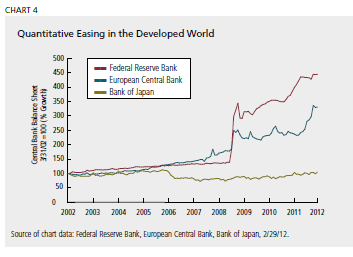
Global injections of central bank liquidity (see Chart 4) have done a lot to arrest the decline of asset prices. And given that economies are still deleveraging, we’re not seeing the creation of a new bubble. Secondly, we’re continuing to see signs of economic improvement, notably in the U.S., as my colleague Jerry Webman explains more fully in these pages. The third reason relates to valuations and interest rates.
While the price-to-earnings ratio of the S&P 500 Index may not seem too inspiring at current levels near their historical averages, there’s more to this picture than meets the eye. Flip the ratio around and you get stocks’ earnings yield, an interest rate that lets you make an apples-to-apples comparison with bonds. As of the end of February, the S&P 500’s earnings yield was 7.1% compared to a yield of 2.0% on the “risk-free” 10-year Treasury. Which rate would you rather compound for 10 years?
The relative value between stocks and treasury bonds is as out of whack as it was in the Great Depression. In retrospect, stocks were the far better choice than bonds for the following decade. Past performance does not guarantee future results, but such may be the case again. Remember, short-term bond yields are close to zero. It’s not a big hurdle to jump. But what if earnings growth is tepid? How will stock prices advance? The answer is that the difference between earnings yield and interest rates will likely help push equity multiples, and therefore prices, higher.
The (not so) bad
Now, what about the risks we face? While the global central bank liquidity cycle has helped put a floor under asset prices, we have to wonder what happens when the banks start winding it down? We’re not at that point yet, though I don’t expect many more large additional provisions to be announced. To paraphrase Winston Churchill, we’re not at the end of the cycle, or even at the beginning of the end, but perhaps we’re at the end of the beginning. I’m actually looking forward to the end of the beginning; when the Fed eventually announces that it’s going to start normalizing interest rates, markets will most likely catch a case of the vapors and sell off. That will be a buying opportunity, since it will mean that the economy is returning to full health. The long night will finally be over.
As for the European sovereign debt crisis, I argued in January that while the collapse of the Eurozone seemed to have become increasingly plausible, European Central Bank intervention would most likely head off such an outcome. That’s exactly what happened. The ECB’s actions did not “fix” Europe, but by providing the financial system with nearly infinite liquidity indefinitely, it severed the principal transmission mechanism through which a Eurozone meltdown could have occurred. Greece, for its part, is still a terminally leaky ship, but its fate is no longer as critical to markets as it once was.
Geopolitical risk is a wild card, but hasn’t it always been? I’m no Pollyanna, but there’s constantly something dangerous going on in the world for investors to fear. Through it all, companies keep trying to innovate and grow, and investors have worked toward meeting their future liabilities.
As we weigh the good versus the bad, let’s also remember to keep an eye on the biggest of big pictures. When we take a step back and think about the most large-scale, long-term trends affecting the global economy, I personally think it’s hard not to be bullish. I could be accused of lacking imagination, but as an investor, I have to be excited by phenomena such as the continuing rise of an emerging market middle class. The world is changing fundamentally, and our job as investors is to recognize such changes and try to capitalize on them.
High yield fixed income—Love it, love it, love it
In our Quarterly Market Review: 2012 Outlook, I wrote that high yield and senior floating rate bank loans were at the top of my list of potentially promising investment opportunities, and they emphatically still are.
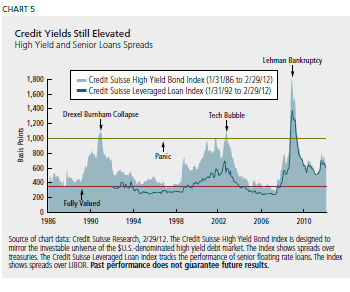
Spreads—in this case, the yield premium markets assign below-investment-grade bonds above treasury yields—remain wide by historical standards, largely due to fears over issuers’ creditworthiness (see Chart 5). I’m not losing much sleep, however. That spread is my compensation for the risk they might default. When I buy a bond that might default, I consider what the likely “recovery value” might be. When I buy a portfolio of such bonds, I consider the yield I need to break even with treasury bonds under my default and recovery assumptions. At today’s yields, for investors with a five-year investment horizon, so-called junk bonds could weather a worse scenario than 2008/2009 with respect to defaults and still outperform treasuries. Presently, the Barclays Capital U.S. High Yield Index2 yields about 7.25%. This is higher than the current earnings yield on stocks—for securities that are senior in the capital structure to common equity.
Many companies are booking record profits and are sitting on a massive pile of cash. If the economy keeps improving, companies’ creditworthiness should improve, causing spreads to narrow and generating potential capital gains. But even if 2012 turns out to be 2011 all over again, high yield debt may offer enough of a cushion to allow investors to simply bide their time and clip their bonds’ handsome coupons while they wait for better days.
Dividend equity story still looks attractive
Companies may be generating strong free cash flow, and many are using it to pay a dividend, but payout ratios are miserly. Everybody’s still hoarding cash. Great for high yield investors, but annoying for dividend equity holders. The good news, in my view, is that 2012 will be the year when that changes. Investors are demanding it, and if you don’t believe me, ask the ghost of Steve Jobs. Particularly for European firms, whose zip code has suddenly made them radioactive, CFOs have a strong incentive to either initiate or increase dividends.
Though dividend payers have lagged broader developed-market stock indices so far in 2012 (thanks not exactly to Steve Jobs but to the wild outperformance of his until recently dividend-free former company), they offer higher yields than both the U.S. 10-year Treasury and the German 10-year bund, both of which guarantee a capital loss once interest rates eventually rise. And while dividend payers offer exposure to earnings growth, they also provide potentially defensive characteristics. Dividend payers—and particularly dividend growers—tend to have strong balance sheets, which have helped them in modest growth environments. Over the past 40 years, companies that have initiated and grown a dividend have outperformed those that don’t pay a dividend by over 8% on an annualized basis, and did so with less volatility.3
Emerging market equities: Don’t listen to me
(or anyone else)
Emerging markets stocks have had a good run so far in 2012, following a rocky 2011. Valuations remain well below their historical average, and lessening global risk aversion should continue to provide a tailwind. If Chinese growth disappoints this year, it’s always possible that emerging market equities could see another hiccup. Nevertheless, I believe this would represent a buying opportunity for investors with a longer time horizon, which brings me to an important point: Emerging markets likely represent the single greatest investment opportunity of our lifetimes— but it is a long-term opportunity. It is also true that the greatest beneficiaries will be companies that service consumers in those markets, wherever they are domiciled.
The rise of the emerging world is taking place at warp speed by historical standards, but it’s a story that will nonetheless take decades to play out. The ride will not be smooth. Unfortunately, skittish investors have a habit of allowing themselves to be tossed hither and yon on the seas of volatility, buying high and selling low. So forget short-term forecasts, including my own. In following the short-term advice of pundits and commentators too closely, investors risk creating capital losses even as they seek to hide from them. Just make a long-term plan and stick to it.
International bonds: Beware behavioral biases
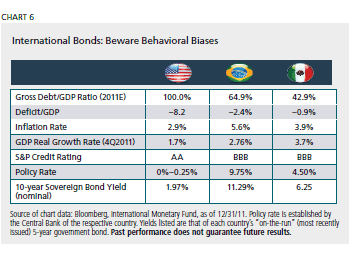
If a bond analyst from Mars were to land on Earth and start comparing developed and emerging market balance sheets and interest rates, he or she (or it) would wonder why heavily indebted, low growth developed economies command lower yields than fiscally healthier, faster growing emerging economies (see Chart 6). I wouldn’t have a rational explanation. My suspicion is that behavioral biases are at work. Investors have long memories of runaway inflation and economic mismanagement in the developing world, but such views are largely out of date.
At a time when negative real yields are devouring U.S. Treasury investors’ purchasing power, and when treasury investors are guaranteed to lose money when interest rates rise, locally denominated emerging market debt currently offers generally higher yields and high credit quality coupled, in many cases, with central banks’ proven inflation-fighting credentials and the policy flexibility to counter slowing growth rates.
Developed market international bonds may not offer the same income potential as their emerging-market counterparts, but they shouldn’t be written off entirely. Fixed income and currency exposure to the U.S.’ largest trading partners may help ease the pain from the rising prices of imported goods. Even battered Europe’s progress in stanching the sovereign debt crisis has offered, and may continue to offer, potential trading opportunities, particularly if over-indebted but still-salvageable Eurozone economies continue to strengthen their balance sheets.
What it means for investors
Despite the run-up in asset prices we’ve seen so far this year, massive global liquidity injections, areas of improving economic fundamentals and attractive valuations in risk assets offer reason for continued optimism. I see plenty of potential value available to investors, especially in high yield bonds, dividend stocks, emerging market equities and international bonds.
Risks to Consider
Fixed income investing entails credit risks and interest rate risks. When interest rates rise, bond prices generally fall, and a fund’s share price can fall. Below-investment-grade (“high yield” or “junk”) bonds are more at risk of default and are subject to liquidity risk. Senior bank loans are typically lower rated and may be illiquid investments. Foreign investments may be more volatile and involve additional expenses and special risks, including currency fluctuations, foreign taxes, and political and economic factors. Emerging and developing market investments are especially volatile. There is no guarantee that the issuers of the stocks held by mutual funds will declare dividends in the future or that if dividends are declared, they will remain at their current levels or increase over time.
1. Source of data: Arthur Burns, “The Anguish of Central Bankers,” http://www.perjacobsson.org/lectures/1979.pdf
2. The Barclays Capital U.S. High Yield Index covers the universe of fixed rate, non-investment grade debt. Eurobonds and debt issues from countries designated as emerging markets (sovereign rating of Baa1/BBB+/BBB+ and below using the middle of Moody’s, S&P and Fitch) are excluded, but Canadian and global bonds (SEC registered) of issuers in non-EMG countries are included. Original issue zeroes, step-up coupon structures, 144‑As and pay-in-kind bonds (PIKs, as of October 1, 2009) are also included. Sectors: The index includes both corporate and non-corporate sectors. The corporate sectors are industrial, utility and finance, which include both U.S. and non-U.S. corporations. The Yankee sector has been discontinued as of 7/1/00. The bonds in the former Yankee sector have not been removed from the index, but have been reclassified into other sectors.
3. Source of data: Ned Davis Research, Inc., 12/31/11.
Shares of Oppenheimer funds are not deposits or obligations of any bank, are not guaranteed by any bank, are not insured by the FDIC or any other agency, and involve investment risks, including the possible loss of the principal amount invested.
These views represent the opinions of OppenheimerFunds, Inc. and are not intended as investment advice or to predict or depict performance of any investment. These views are as of the open of business on April 10, 2012, and are subject to change based on subsequent developments.
Before investing in any of the Oppenheimer funds, investors should carefully consider a fund’s investment objectives, risks, charges and expenses. Fund prospectuses and summary prospectuses contain this and other information about the funds, and may be obtained by asking your financial advisor, visiting oppenheimerfunds.com or calling 1.800.CALL OPP (225.5677). Read prospectuses and summary prospectuses carefully before investing.
Oppenheimer funds are distributed by OppenheimerFunds Distributor, Inc.
Two World Financial Center, 225 Liberty Street, New York, NY 10281-1008
© 2012 OppenheimerFunds Distributor, Inc. All rights reserved.
CM0000.016.0412 April 10, 2012