Strategies for Speculating on the Crisis in Japan
Membership required
Membership is now required to use this feature. To learn more:
View Membership BenefitsAdvisor Perspectives welcomes guest contributions. The views presented here do not necessarily represent those of Advisor Perspectives.
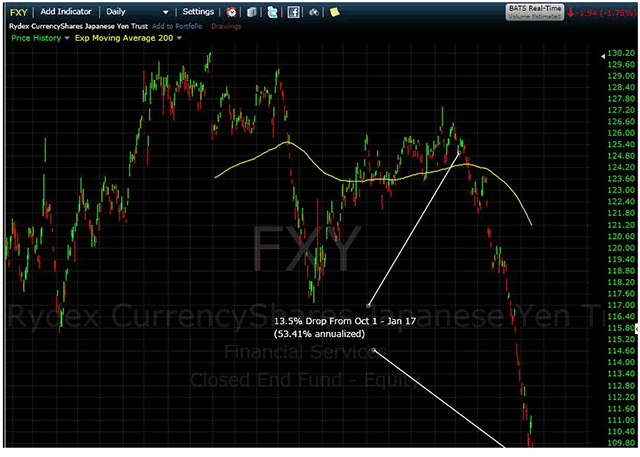
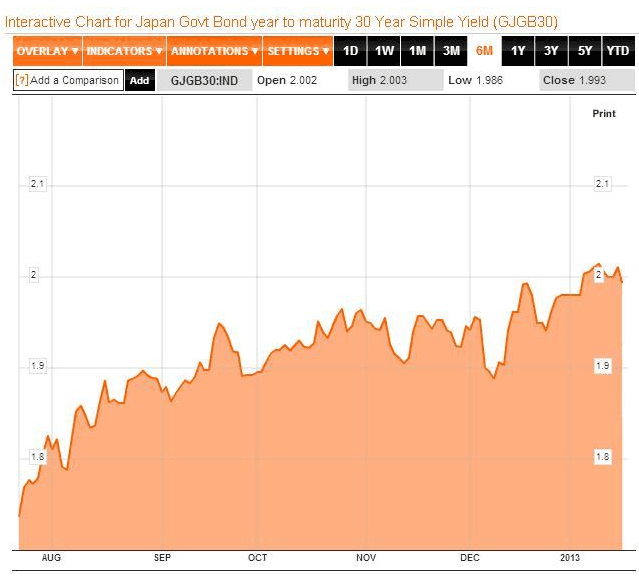
Bears on Japan are finally, after nearly two decades of being on the wrong side of the market, getting some vindication. The end of 2012 was marked by a significant decline in the Japanese yen and a rise in the yield on 30-year Japanese Government Bonds (JGBs). The charts below illustrate those movements.
Should those trends continue, the conventional wisdom is that investors will do best by shorting JGBs. But a superior strategy is to short the yen itself.
I’ll explain my investment thesis, but first let’s look at Japan’s fiscal situation and why it is likely to deteriorate in the near term.
Japanese yen, as measured by its corresponding ETF (FXY)
30-year Japanese Government Bonds
Japan’s escalating crisis
The reasons for Japan’s fiscal crisis have been widely documented and have been building for some time. To summarize, Japan faces three distinct problems:
- Debt: Japan’s debt-to-GDP ratio is over 211%, the highest of any major economy in the world. Even Greece, whose debt crisis has received much attention and resulted in great political turmoil over the last several years, has a lower debt-to-GDP ratio of 171% (Source: TradingEconomics). Japan’s debt relative to the size of its economy means Japan will not be able to repay its debt. The implication of this is that the Bank of Japan (BOJ) will need to print more yen to pay Japan’s debt, thus devaluing the yen, or investors will see the situation for what it is and begin shorting the yen.
- Demographics: Japan’s population is aging and not being replaced. The country’s population is declining in absolute terms, and the country sells more adult diapers than baby diapers (Source: Bloomberg). The Japanese economy will increasingly be characterized by greater social security expenses coupled with a declining tax base. As such, cutting government spending to balance the budget will be even more difficult, and the need for new debt will only grow.
- Dearth: Japan lacks natural resources. This was highlighted after the March 2011 Fukushima disaster, which resulted in the country shutting down its entire fleet of nuclear reactors. Because Japan lacks natural resources for energy production, the country was forced to significantly increase its imports of liquefied natural gas. Japan became a net importer and thus fell into the precarious situation of running twin deficits. The Japanese government was spending more than it was taking in via taxes (a budget deficit), and importing more than it was exporting (a trade deficit). This made the Japanese economy increasingly dependent on others – a condition that can be particularly problematic during international conflict, which Japan is also facing.
For a more comprehensive assessment of the problems facing Japan, see this video from Kenai Capital Management fund manager Tres Knippa.
Ways to speculate on Japan’s debt crisis
My preference is to short the Japanese yen. I prefer this to shorting the Japanese bond market. There are several reasons for this:
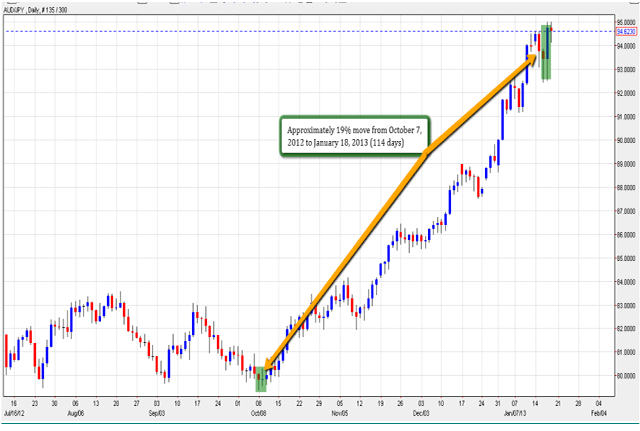
- Shorting the yen offers a carry trade, which has historically worked very well for speculators willing to hold positions for several years. The carry trade involves borrowing a currency with low interest rates – such as the Japanese yen – and using it to purchase a currency with high interest rates (like the Australian dollar). The investor earns a fixed income stream due to the interest rate differential in addition to the exchange rate arbitrage – similar to buying dividend-yielding value stocks. The Australian dollar has recently outpaced virtually all other major currencies against the yen. The chart below illustrates.
AUD/JPY
- I consider it quite likely that JGBs will provide short sellers with immense profits in the years to come. However, I am wary of the BOJ’s ability to keep this market propped up. If an asset is denominated in yen – such assets include Japanese real estate, the Nikkei and JGBs – then the BOJ has the ability to print yen to keep the asset prices propped up (especially if the BOJ is losing the independence it may have had previously). To understand this concept better, consider the relationship between the U.S. dollar and U.S. Treasury bonds over the past decade. Like Japan, the U.S. has a central bank that buys debt in a currency it issues (i.e., U.S. Treasury bonds are denominated in U.S. dollars). The U.S. dollar, mired by twin deficits (as is Japan), has declined steadily over the past decade – but Treasury bonds have rallied.
USDX versus TLT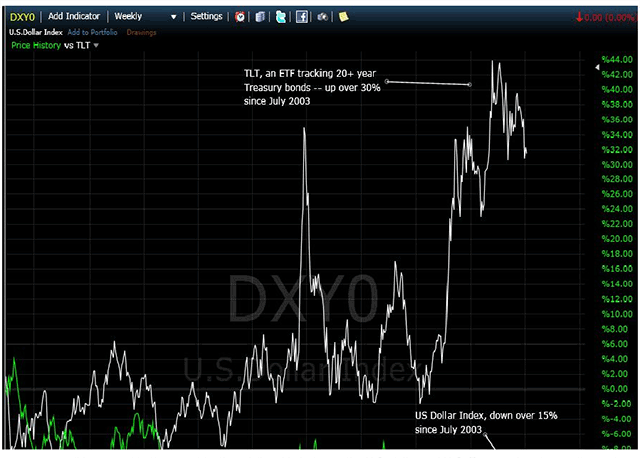
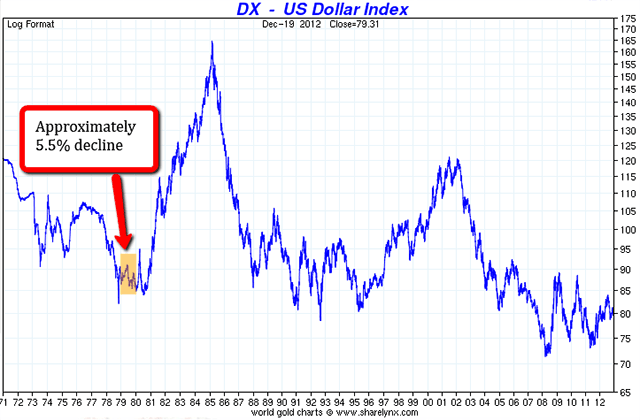
Despite my preference for shorting the yen, it is worth elaborating on the argument that JGBs will fall more than the yen. This viewpoint stems from the historical precedent established in the late 1970s, when the world was in a similar situation. The U.S. dollar was weakening, gold was rallying and concerns about a run on the dollar were growing. Federal Reserve Chairman Paul Volcker raised interest rates in the early 1980s, sending bond prices down significantly. From 1979 to 1980, the period prior to the rate hike that caused gold to skyrocket, Treasury bonds declined more than the U.S. dollar did.
30-year Treasury Bond, 1979-1980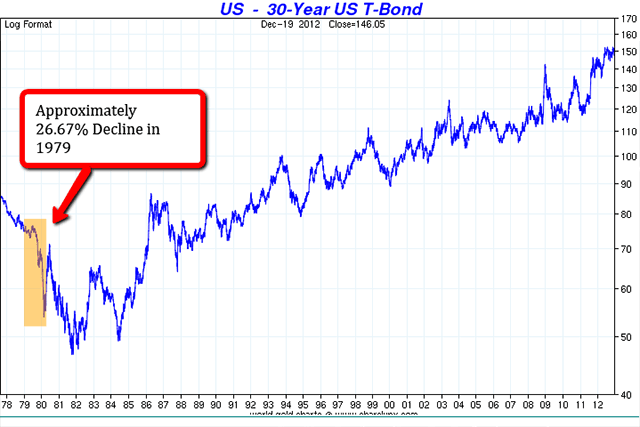
U.S. dollar index, 1979-1980
This situation is unlikely to repeat in either the United States or Japan, because both countries run a budget deficit. An interest rate hike would drive their interest expenses to unsustainable levels. John Mauldin observed that a 2% hike in interest rates on 10-year JGBs would result in Japan spending over 50% of its tax revenue on interest alone. An interest rate hike cannot be part of the solution unless it is coupled with some type of debt cancellation or restructuring.
And therein lies the missing piece of the puzzle to how markets will respond to the Japanese debt crisis as it escalates. Ultimately, a new international monetary agreement involving some type of debt cancellation or restructuring is inevitable, given the amount of debt the large economies of the world are encumbered with. The nature of this debt cancellation, which will be a political decision, will impact prices greatly.
Although the yen has begun to unravel and the JGB market is increasingly unstable, investors still have time to get in on this opportunity. The Australian dollar-Japanese yen exchange rate, with carefully managed leverage, offers the best risk-reward tradeoff. It is best to play this via the spot-forex market, but those most comfortable with exchange-traded funds (ETFs) traded on U.S. exchanges can create a synthetic position that is long on the Australian dollar and short on the Japanese by acquiring the CurrencyShares Australian Dollar Trust (FXA) and ProShares UltraShort Yen (YCS). YCS is a levered ETF designed to double the impact of changes in the U.S. dollar-Japanese yen exchange rate. So if one wishes to create an Australian dollar-Japanese yen position using YCS, the position should be approximately half the size of the corresponding position in FXA. Levered ETFs also require closer attention to ensure they are moving as expected in relation to the underlying assets.
Outside of strategies for speculating upon the Australian dollar-Japanese yen exchange rate, individuals and institutions that are planning to take on debt with a five-to-seven-year maturity can also benefit by exploring ways their long-term debt can be denominated in yen. This strategy, advocated by Kyle Bass and John Mauldin, does not necessarily require a bank to issue a loan in yen. Rather, the debt one has incurred in U.S. dollars or other currencies can be hedged via the spot-forex market or the aforementioned exchange-traded fund, YCS.
Simit Patel is a trader with 10+ years experience in the foreign exchange markets. His career has involved working as a licensed currency broker, providing consulting services to forex trading firms, and developing educational products for brokerage firms. He is the founder of InformedTrades.com, an online community dedicated to helping individuals learn to trade the world’s financial markets.
Membership required
Membership is now required to use this feature. To learn more:
View Membership BenefitsSponsored Content
Upcoming Virtual Events View All